|
STATE OF CONNECTICUT
TOWN OF GREENWICH
A regular Representative Town Meeting of the Town of Greenwich will be held in the Moderator’s Hall of Central Middle School on Monday September 20, 2010 at 7:00 P.M.(E.D.T.) for the following purposes:
1. To consider and act upon the following resolution, requested by the Legislative and Rules Committee.
Child Safety Zone Ordinance.
1. Purpose.
The Connecticut Legislature has determined that persons convicted or found not guilty by reason of mental disease or defect [Connecticut General Statutes sec. 54-250(6), as amended] of certain criminal offenses against minors and sexually violent offenses, present a continuing danger to the health and safety of the public, sufficient to require that such persons register with the Connecticut Commissioner of Public Safety. Several of the registered individuals live in the Town of Greenwich. The Town of Greenwich's parks, playgrounds, educational, recreational and sports facilities are provided and furnished for the use of children and families, and the Town of Greenwich has a compelling interest in protecting children from the threat of sexual abuse and predation.
2. Definitions. The following terms shall have the following meanings:
a. Child Safety Zone: Any public playground, recreation and/or teen center, sports facility and playing field, school or educational facility (excluding, however, any public library), including land on which such facilities are located which is used for educational, recreational, sports, youth activities or child-care purposes and which is owned or leased by any municipal agency including, without limitation, the Board of Education, the boundaries of which have been delineated by the municipal agency having jurisdiction over such facility and approved by the Board of Selectmen and the Representative Town Meeting pursuant to Section 4 below. "Child Safety Zone" does not include any public street or highway, nor does it include a sidewalk that is located adjacent to the land on which a public playground, recreation and/or teen center, sports facility or field, school or educational facility is located, but “Child Safety Zone” does include a sidewalk that runs through such area.
b. Sex Offender: Any person who has been convicted or found not guilty by reason of mental disease or defect, in this or any other state (including without limitation the District of Columbia and any territory of the United States), jurisdiction or federal military court, of a “criminal offense against a victim who is a minor" or a “nonviolent sexual offense," against a minor, a "sexually violent offense" against a minor or any felony that the court has found "was committed for a sexual purpose" against a minor (including, without limitation, Public Indecency, Breach of Peace, Risk of Injury to a Minor, Sexual Assault, Promoting Prostitution, Enticing a Minor, Kidnapping, Unlawful Restraint, Employing a Minor in an Obscene Performance, Importing Child Pornography and Possessing Child Pornography), and who is required to register with the Registry as a result of criminal activity pursuant to any provision of the Connecticut General Statutes, as amended, or is required to register with the Registry of any other state (including without limitation the District of Columbia and any territory of the United States).
c. Permitted Activity by a Sex Offender: Any one or more of the following activities by a Sex Offender:
(1) Any Sex Offender entering into a facility in a Child Safety Zone for the sole purpose of voting in any municipal, state or federal election or referendum, or attending or participating in a municipal, state or federal public meeting, including but not limited to, public meetings of the Board of Selectmen, Board of Estimate and Taxation, municipal departments, or the Representative Town Meeting, or attending or participating in a private meeting with any municipal official or employee, provided that the Sex Offender leaves the facility immediately after voting or after the conclusion of such meeting;
(2) Any Sex Offender who is a custodial parent and enters a Child Safety Zone for the sole purpose of dropping off or picking up his or her child, provided the Sex Offender leaves the zone immediately after dropping the child off or picking the child up;
(3) Any Sex Offender who has been authorized in writing by a custodial parent and enters a Child Safety Zone for the sole purpose of dropping off or picking up such custodial parent’s child, provided the Sex Offender leaves the zone immediately after dropping the child off or picking the child up;
(4) Any Sex Offender who is a custodial parent and enters a Child Safety Zone for the sole purpose of meeting with an adult to discuss such child's medical care or condition or educational program, including, without limitation, meeting with such child's teachers, school nurses, faculty members and/or school staff members, provided such Sex Offender leaves the facility immediately upon completion of such meeting;
(5) Any Sex Offender who is a custodial parent, relative, or guardian of his or her child or children and enters a Child Safety Zone for the purpose of attending any event or activity in which said child or children are participants or spectators which are customarily attended by the parents of such children, including but not limited to academic events such as graduation from any school or educational facility or recognition of academic achievement at any school or educational facility, theatrical or musical events such as plays or recitals, and athletic events and recreational activities such as sporting events or games, provided such Sex Offender leaves the Child Safety Zone immediately upon completion of such event or activity.
(6) Any Sex Offender entering into the areas of a public playground, recreation center, sports facility or field delineated as part of a Child Safety Zone with his or her family (including at least one other related adult) or his or her adult friends (including any adult sports team) for the purpose of engaging in sports activities with his or her family or his or her adult friends, provided that such Sex Offender remains with his or her family or his or her adult friends at all times and leaves such public playground, recreation center, sports facility or field immediately upon completion of such activity.
(7) Any Sex Offender entering a Child Safety Zone as required by his or her employer .
(8) Any Sex Offender entering a public school or other municipal facility for the purpose of participating in Continuing Education, provided that such Sex Offender leaves the school or facility immediately upon completion of such activity.
(9) Any activity by a Sex Offender in a Child Safety Zone authorized by a permit issued by the Greenwich Chief of Police or his designee pursuant to an application submitted by or on behalf of such Sex Offender on a form prescribed by the Greenwich Chief of Police or his designee and approved by the Board of Selectmen and the Representative Town Meeting.
d. Registry: A central record system established in Connecticut, in any other state (including without limitation the District of Columbia and any territory of the United States), or by the federal government that receives, maintains and disseminates information on persons convicted or found not guilty by reason of mental disease or defect of a "criminal offense against a victim who is a minor" or "a nonviolent sexual offense," a "sexually violent offense" or any felony that the court has found "was committed for a sexual purpose" as those terms are defined in Connecticut General Statutes Sections 54-250, Subsections (2), (5), (11) and (12).
3. Prohibition.
It shall be unlawful for a Sex Offender to be present in any Child Safety Zone.
The provisions of this Ordinance shall not apply to the following:
a. Any person whose name has been removed (1) from the Connecticut Registry or (2) from the Registry of any other state or in the federal or military system by act of a court or by expiration of the term for which such person is required to remain on such Registry and whose name is not included on the Connecticut Registry.
b. Any Permitted Activity by a Sex Offender.
c. This Ordinance shall not apply to the extent that the conduct which is prohibited is in conflict with the terms of a judicially imposed sentence, order of probation or condition of parole which has been imposed upon a specific individual who is a Sex Offender.
4. Delineation of Child Safety Zone Boundaries.
The municipal agency having jurisdiction over a facility that includes areas that could qualify as a Child Safety Zone (for example, the Board of Education in the case of a public school or the Department of Parks and Recreation in the case of a public playground or sports facility) shall delineate on a map of the facility the areas within the facility where children under the age of eighteen are expected to use the facility, and such areas shall constitute a Child Safety Zone. Areas of the facility used primarily by adults shall be excluded from the Child Safety Zone. Each such agency shall complete its work within six months of the RTM’s approval of this ordinance and present the map(s) to the Board of Selectmen who shall conduct at least one public hearing before approving any map. The Board of Selectmen shall submit all approved maps to the Representative Town Meeting for final approval or rejection.
5. Notice.
The Greenwich Chief of Police or his designee shall make reasonable efforts to provide prompt, actual written notice of the enactment of this Ordinance (which notice shall contain a copy of this Ordinance) to all persons who are listed on the Registry who reside in Greenwich, as well as to those persons who are thereafter added to the Registry and reside in Greenwich, and registrants who move to Greenwich. Such notice requirement may be satisfied by the mailing of such notice by registered or certified mail, return receipt requested, to the last known address of such person as listed on the Registry or as otherwise known to the Greenwich Chief of Police. The failure of any person to receive such actual written notice shall not be a defense to a violation of this Ordinance.
Each Child Safety Zone shall be identified as such by a sign or signs conspicuously posted at each of the primary entrances of or within the Child Safety Zone. The sign or signs shall provide a warning that the area is a Child Safety Zone and that the presence therein or thereon by a registered Sex Offender is a violation of this Ordinance and is punishable by a fine.
6. Enforcement.
If a police officer reasonably believes that a Sex Offender is in a Child Safety Zone in violation of this Ordinance, the officer shall require the suspected Sex Offender to provide his or her name, address, and telephone number. If it is established that the individual is a Sex Offender and is not engaged in a Permitted Activity, the officer shall then issue a written warning that such person is in violation of this chapter and require this person to leave the Child Safety Zone.
If the person who is a Sex Offender and who is not engaged in a Permitted Activity refuses to leave or is later found to be in the same or any other Child Safety Zone, the officer may issue a citation, and penalties set forth in subsection 7 of this Ordinance shall apply.
7. Penalties.
Any person who is a Sex Offender and is issued a citation because of a violation of this Ordinance shall be fined in the amount of One Hundred Dollars ($100.00) for each violation. Fines under this Ordinance shall abate in the event that the prohibited conduct results in a conviction for a new criminal offense under any applicable state or federal law or when the prohibited conduct is the basis for and results in the revocation of any term of parole or probation.
Referred to Education Committee
Referred to Legislative & Rules Committee
Referred to Parks & Recreation Committee
2. To consider and act upon the following resolution, requested by the Commissioner of Public Works and approved by the First Selectman and the Board of Selectmen.
WHEREAS, the Town of Greenwich has published a legal notice & display ad, mailed a news release to a number of officials and agencies, and mailed a formal letter to abutting property owners, announcing a hearing on the proposed STP Urban Transportation project known as State Project 56-301, The Replacement of Bridge No. 05014 carrying Riversville Road over the Byram River, Town Project Number 05-13; and WHEREAS a public informational meeting was held on June 17, 2010, at Town Hall, 101 Field Point Road, Greenwich, CT, at 7:00 p.m., at which hearing residents had an opportunity to voice their concerns; and WHEREAS, the South Western Regional Planning Agency has selected this project as a regional priority and has agreed to utilize federal funds for engineering, right-of-way and construction activities; and WHEREAS, the project is located on a municipally-owned road, the preliminary engineering phase has been performed by our consultant, Stantec Consulting Services, Inc., the final design, the rights-of-way and construction phases will be funded 80% by the Federal Highway Administration, 10% by the State of Connecticut and 10% by the Town of Greenwich; and WHEREAS, the Representative Town Meeting (RTM) has considered the concerns of the residents from the public informational meeting and finds that the proposed Replacement of Riversville Road Bridge is in the best interest of the Town of Greenwich, and will promote the health, safety and general welfare of its residents and provide for convenience and safety of the motoring public.
WHEREAS, the Town of Greenwich based on the above information, and by virtue of this resolution, hereby fully supports the proposed project.
Signed: _____________________________________
Dated: _____________________________________
Referred to Finance Committee
Referred to Public Works Committee
Referred to Transportation Committee
3. To consider and act upon the following resolution:
Referred to Appointments Committee
Referred to Education Committee
4. To consider and act upon the following resolution, requested by Commissioner of Public Works and approved by the First Selectman and the Board of Selectmen.
CHAPTER 9. WASTE AND LITTER [REFUSE].
ARTICLE 1. WASTE COLLECTION AND [REFUSE AND GARBAGE] DISPOSAL.
Sec. 9-1. Definitions.
(a) As used in this article [chapter]:
(1) Acceptable solid waste shall mean unwanted or discarded materials, garbage and refuse that the town is permitted by the state to collect, store and transport from the town disposal area to resource recovery combustion facilities or landfills that are licensed to accept municipal solid waste but shall not include recyclable materials, bulky waste or hazardous waste.
(2)[(1)] Approved containers shall mean covered, watertight containers.
(3)[(2)] Approved vehicles shall mean a conveyance equipped with fully enclosed metal bodies of the type designed and maintained to promote the absence of leakage or spillage and approved by the Superintendent [Director of Health].
[(3) Combustible refuse shall mean paper, cartons, rags, old clothes, small pieces of wood, leather and metal containers of not over one (1) quart's capacity.]
(4) Bulky waste shall mean land clearing, demolition and construction debris, discarded machinery and equipment, and other unwanted materials that cannot be feasibly disposed of at resource recovery combustion facilities and landfills as acceptable solid waste because of size or non-combustibility but which can be disposed of at specially permitted and available landfills as determined by the Superintendent.
(5) Commissioner shall mean the Commissioner of Public Works or by the designation of the Commissioner the Deputy Commissioner of Public Works.
(6) [(4)] Garbage shall mean every accumulation of animal, vegetable or other putrescible matter including that attend[s]ing the preparation, consumption, decay, dealing in or storage of meats, fish, fowl, birds, fruit, vegetables, beverages or other edibles, including the [cans,] non-recyclable materials of containers or wrappers disposed of along with such materials.
(7) Hazardous waste shall mean pathological and biomedical discarded items, sewage sludge, gunpowder, dynamite, cartridges, shells, gasoline, naphtha, benzene, ether and other refuse materials that have flammable, explosive, corrosive, toxic , infectious or reactive characteristics that when present in significant quantities require special handling for collection, transport and disposal in accordance with applicable state or federal law.
(8) Recyclable materials shall mean the materials defined in Sections 8A-2 and 8A-3 of the Code.
(9) Superintendent shall mean the Superintendent of the Department of Public Works Recycling, Waste Collection and Disposal Division.
[(5) Waste material shall mean bricks, plaster, furniture and all other noncombustible refuse which has been discarded.]
(Ords. & Reg., § 2-11.1, 2/1/1940.)
Sec. 9-2. Accumulation prohibited.
The accumulation of acceptable solid waste [garbage, combustible refuse] or waste material of any kind not otherwise provided for in this chapter except in approved containers is prohibited.
(Ords. & Reg., § 2-11.2, 2/1/40.)
Sec. 9-3. [Garbage and refuse] S[s]torage containers.
Acceptable solid waste [Garbage and combustible refuse] shall be stored in approved containers. All garbage shall be drained and wrapped [in paper] before it is placed in the containers. The containers shall be kept in a clean and sanitary condition.
(Ords. & Reg., § 2-11.3, 2/1/40.)
Sec. 9-4. [Garbage and refuse] C[c]ollection.
All acceptable solid waste [With the exception of recyclables as defined in Section 8A-2 of the Greenwich Municipal Code, all garbage and refuse, in approved containers,] shall be removed in approved containers or approved vehicles at least once a week unless more frequently [otherwise] required by the Superintendent or Director of Health.
(Ords. & Reg., § 2-11.4, 2/1/1940; 8/26/1991.)
Sec. 9-5. Transport and disposal [Incineration] required; [permit; exceptions].
[(a)] All acceptable solid waste [garbage and refuse] shall be transported to the town disposal area. All bulky waste [material] shall be loaded and transported to any place as directed and designated by the Superintendent [Director of Health].
[(b) The Director of Health may in special instances grant permits for the disposal of garbage and combustible refuse by burial or incineration upon the premises where it originates. The Director of Health may in special instances grant permits for installation and maintenance of garbage grinders for the disposal of garbage into a septic tank.]
(Ords. & Reg., § 2-11.5, 2/1/40.)
Sec. 9-6. Delivery from outside town.
No acceptable solid waste, bulky waste or hazardous waste [garbage, combustible refuse or waste materials] shall be transported for disposal into the town from any place beyond the limits of the town[.] unless otherwise approved in writing by the Commissioner as part of a reciprocal municipal cooperative aid agreement.
(Ords. & Reg., § 2-11.7, 2/1/40.)
Sec. 9-7. License to transport; application.
(a) No person shall engage in the business of transporting acceptable solid waste to the town disposal area [garbage, combustible refuse or waste material] without having a valid license from the Superintendent [Director of Health] and without using an approved vehicle.
(b) The application for a license valid for one (1) year shall be on a form furnished by the Superintendent [Director of Health].
(Ords. & Regs., §§ 2-11.9.1, 2-11.9.2, 2/1/1940.)
Sec. 9-8. License revocation; hearing.
(a) The Commissioner [Board of Health] shall have the power to revoke the license of any waste [refuse] collector found not to be operating in compliance with the provisions of this Code.
(b) No order of revocation shall be made except after a hearing. When a license has been revoked another license shall not be issued except with the approval of the Commissioner [Board of Health].
(Ords. & Reg., § 2-11.9.3, 2/1/1940.)
Sec. 9-9. Approved [Refuse] vehicles; numbers; maintenance.
(a) Every approved vehicle of a licensed waste [refuse] collector under these regulations shall have conspicuously displayed on each side a number issued by the Superintendent [Director of Health].
(b) Every approved vehicle used in the transportation of waste [refuse] shall be kept in a sanitary condition.
(Ords. & Reg., §§ 2-11.9.4, 2-11.9.5, 2/1/1940.)
Sec. 9-10. Delivery of acceptable solid waste [refuse].
All acceptable solid waste [garbage and combustible refuse] shall be promptly delivered at the town disposal area [incineration plant] on the same day that it is placed into the approved vehicle [truck].
(Ords. & Reg., § 2-11.9.6., 2/1/1940.)
Sec. 9-11. Prohibited substances.
No hazardous waste [gunpowder, dynamite, cartridge, shell, gasoline, naphtha, benzine, ether or any other explosive or similarly dangerous substances or material] shall be cast into any approved container or transported as acceptable solid waste to the town disposal area [incinerator]. The Superintendent may adopt procedures for the acceptance of specific items of hazardous waste at specific areas of the town disposal area or direct their delivery to designated facilities to be handled and disposed of in accordance with state and federal law.
(Ords. & Reg., § 2-11.6, 2/1/1940.)
Sec. 9-11.1. Penalty; appeal; hearing
(a) Violation of the provisions of this article affecting the delivery of waste to the town disposal area or such other place as directed by the Superintendent shall be subject to civil penalty fines of up to one hundred dollars ($100) for a first violation, two hundred fifty dollars ($250) for a second violation and one thousand dollars ($1,000) for each subsequent violation. The Superintendent may impose such fines on the transporter if the waste in violation is more than one (1) cubic foot in volume and it exceeds five percent (5%) of the load transported. Fines for the first two discoveries of violation may be avoided in the first instance by the transporter remedying the violation by delivering the waste to the disposal place designated by the Superintendent and in the second instance by the transporter paying the disposal fee or charge incurred by the town and providing a written report satisfactory to the Superintendent of the cause of the violation including, if pertinent, the source of the generation of the waste and what corrective measures are being followed. Upon completion of such corrective measures the Superintendent shall clear the record of violations of the transporter. If the transporter is not the generator of such waste and the violation is determined by the Superintendent to be the fault of the generator the Superintendent may impose such fines on the generator.
(b) Civil penalty fines under part (a) of this section shall be payable to the town and may be appealed within ten days to the Commissioner who shall conduct a hearing and render a decision thereon. Any fine determined by the Commissioner in excess of one thousand dollars ($1,000) may be appealed within ten days to the Board of Selectmen which shall designate a hearing officer, not employed by the Department of Public Works, to conduct a hearing and make a recommendation to the Board which shall make a decision on such recommendation.
(c) Any other violation of the provisions this article shall be subject to a fine of up to two hundred fifty dollars ($250).
ARTICLE 2. LITTER.
Sec. 9-12. Definitions.
(a) As used in this [A]article:
(1) Authorized Private Receptacle shall mean a litter storage and collection receptacle as required and authorized by the town [in the Refuse Ordinance of the Town Sanitary Code].
(2) Garbage shall mean and include all putrescible wastes, including vegetable and animal [offal and carcasses of dead animals, but not sewage and body wastes] remnants.
(3) Handbill shall mean any advertisement, sample or device, dodger, circular, leaflet, pamphlet, paper, booklet or any other printed or otherwise reproduced original or copies of any matter or literature.
(4) Landscape Debris shall mean yard waste in accumulations that create a hazard but shall not include during the fall the placement of leaves alongside streets contiguous to one’s property for pickup as designated by the town.
(5) [(3)] Litter shall mean garbage, landscape debris and/or rubbish as defined herein and all other waste material which, if thrown or deposited as herein prohibited, tends to create a nuisance or danger to public health, safety and welfare.
(6) [(4)] Park shall mean a park, reservation, playground, beach, recreation center or any other public area in the town, owned or used by the town and devoted to active or passive recreation.
(7) [(5)] Public Place is any and all streets, sidewalks, boulevards, alleys or other public ways and any and all public parks, squares, spaces, grounds and buildings.
(8) [(6)] Rubbish shall mean and include all nonputrescible waste materials [(except ashes)], including but not limited to paper, cardboard, tin cans, wood, glass, bedding, crockery, refrigerators, junk automobiles, demolition material, tree limbs and industry wastes.
(9) [(7)] Vehicle shall mean every device in, upon or by which any person or property is or may be transported or drawn upon a highway or sidewalk, including devices used exclusively upon stationary rails or tracks.
[(8) Handbill shall mean any advertisement, sample or device, dodger, circular, leaflet, pamphlet, paper, booklet or any other printed or otherwise reproduced original or copies of any matter or literature.]
(10) Yard Waste shall mean branches, brush, leaves, grass clippings, sod, crops, mulch and wood chips.
(Ords. & Reg., § 2-11.8; as amended 11/10/1971; RTM 6/10/1991.)
Sec. 9-13. Litter in public places; use of receptacles.
No person shall throw or deposit litter in or upon any street, sidewalk or other public place within the town except in public receptacles, in authorized private receptacles for collection or in official town disposal areas.
(Ords. & Reg., § 2-11.8; as amended 11/10/1971.)
Sec. 9-14. Manner of placing litter in receptacles.
Persons placing litter in public receptacles shall do so in such a manner as to prevent it from being carried or deposited by the elements upon any street, sidewalk or other public place or upon private property.
(Ords. & Reg., § 2-11.8; as amended 11/10/1971.)
Sec. 9-15. Sweeping litter into gutters prohibited.
(a) No person shall sweep into or deposit in any gutter, street or other public place within the town the accumulation of litter from any building or lot or from any public or private sidewalk or driveway.
(b) Persons owning or occupying property shall keep the sidewalk in front of their premises free of litter.
(Ords. & Reg., § 2-11.8; as amended 11/10/1971.)
Sec. 9-16. Throwing litter from vehicle.
No person, while a driver or passenger in a vehicle, shall throw or deposit litter upon any street or other public place within the town or upon private property.
(Ords. & Reg., § 2-11.8; as amended 11/10/1971.)
Sec. 9-17. Transporting litter; trucks to be covered.
No person shall drive or move any truck or other vehicle within the town unless such vehicle is so constructed, covered or loaded as to prevent any load, contents or litter from being blown or deposited upon any street, alley or other public place.
(Ords. & Reg., § 2-11.8; as amended 11/10/1971.)
Sec. 9-18. Depositing litter in water prohibited.
No person shall throw or deposit litter in any fountain, pond, lake, stream, bay or any other public body of water in the town.
(Ords. & Reg., § 2-11.8; as amended 11/10/1971.)
Sec. 9-19. Littering occupied private property.
No person shall throw or deposit litter on any occupied, open or vacant private property within the town, whether owned by such person or not, except that the owner or person in control of private property may maintain authorized private receptacles for litter collection or recycling areas for yard waste in such a manner that litter will be prevented from being carried or deposited by the elements upon any street, sidewalk or other public place or upon private property.
(Ords. & Reg., § 2-11.8; as amended 11/10/1971.)
Sec. 9-20. Owner to maintain premises free of litter.
(a) The owner or person in control of any private property shall at all times maintain the premises free of litter.
(b) This section shall not prohibit on private property the storage of litter in authorized private receptacles for collection, [or] prevent the storage of wood, [or branches] or the recycling of yard waste [on the owner's premises] that does not constitute a nuisance to neighbors' properties or any public place.
(Ords. & Reg., § 2-11.8; as amended 11/10/1971.)
[Sec. 9-21. Depositing litter on vacant property.
No person shall throw or deposit litter on any open or vacant private property within the town whether owned by such person or not.
(Ords. & Reg., § 2-11.8; as amended 11/10/1971.)]
Sec. 9-21.[1.] Placing handbills on vehicles.
(a) Purpose. The public interest, convenience and necessity require regulating the placement upon vehicles of handbills, to protect the people against litter and the detriment and danger to public health and safety incident to such placement. To that end, the purposes of this section are specifically declared to be as follows:
(1) To protect the people against the health and safety menace and the expense incident to the littering of the streets and public places by the placement of handbills on vehicles.
(2) To preserve to the people their constitutional right to receive and disseminate information by delivering handbills to all who are willing to receive the same.
(b) No person, organization, association or business shall distribute, deposit or throw or cause the distribution, deposit or throwing of any handbill in or upon any vehicle in any public place. The provisions of this section shall not prohibit a person, organization, association or business from handing, transmitting or distributing, without charge to the receiver thereof, a handbill to the owner or other occupant of any vehicle who is willing to accept it.
(RTM 6/10/1991.)
Sec. 9-22.[21.2.] Severability.
If any subsection, paragraph, sentence, clause or phrase of this chapter [section] should be declared invalid by a court of competent jurisdiction, for any reason whatsoever, such decision shall not affect the remaining portions of this chapter [section], which shall remain in full force and effect, and to this end the provisions of this chapter [section] are hereby declared severable.
(RTM 6/10/1991.)
[ARTICLE 3. VIOLATIONS]
Sec. 9-23[2]. Penalty.
Any [person violating any] violation of the provisions of this article [chapter] shall[, upon conviction,] be [fined not more than] subject to a fine of up to two hundred fifty dollars ($250).[one hundred dollars ($100.).]
ARTICLE 3. BOARD OF HEALTH; DIRECTOR OF HEALTH
Sec. 9-24.
Nothing in this chapter shall be construed to limit the power of the Board of Health or the Director of Health as it relates to public health.
Additions bold
Deletions in [brackets]
Referred to Legislative & Rules Committee
Referred to Public Works Committee
5. To consider and act upon the following resolution, requested by the First Selectman and approved by the Board of Selectmen.
Referred to Land Use Committee
Referred to Legislative & Rules Committee
Referred to Transportation Committee
6. To consider and act upon the following resolution, requested by the First Selectman and approved by the Board of Selectmen.
Referred to Finance Committee
Referred to Public Works Committee
7. To consider and act upon the following resolution, requested by the Director of Community Development and approved by the Board of Estimate and Taxation.
- $25,000 to Q19710-59900-21800 (Greenwich Red Cross Motor Services)
- $12,000 to Q19710-59900-21816 (TAG Transportation Services)
- $74,330 to Q19710-59900-21823 (YMCA St. Roch’s Daycare Rehab Phase I)
- $20,640 to Q19710-59900-21826 (Neighbor-to-Neighbor Facility Improvements)
- $40,000 to Q19710-59900-21830 (Pathways, Inc. Emergency Generator at 509 East Putnam Avenue Group Home)
- $18,750 to Q19710-59900-21831 (St. Luke’s LifeWorks Rose Park Roof Replacement Project)
Referred to Finance Committee
Referred to Health & Human Services Committee
8. To consider and act upon the following resolution, requested by the Legislative and Rules Committee.
The new VI.C. reads as follows:
C. CAPITAL PROJECTS REVIEW COMMITTEE
1. Function:
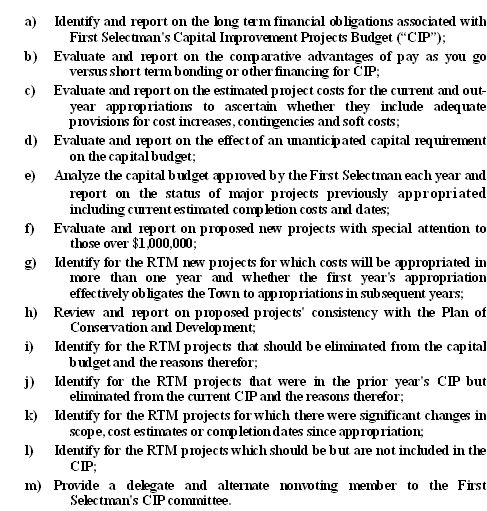
The Capital Projects Review Committee (“CPRC”) shall:
2. Composition:
The CPRC shall consist of twelve (12) members, one from each district, all of whom shall be members of the RTM and who shall be elected by their respective districts for terms expiring at the end of the term of the RTM during which they are elected, provided that the term of each member shall continue thereafter until a successor shall have been elected, and further provided that said members continue to be members of the RTM.
3. Election of Officers:
Within thirty days of the CPRC’s election by the districts, the Moderator will schedule an initial meeting of the CPRC, at which meeting the members shall elect from among its delegates a chairman, vice-chairman and secretary. Votes shall be recorded, and a majority of the committee members shall constitute a quorum. The newly elected chairman shall promptly notify the Town Clerk of such elections, and the Moderator shall announce the election of the committee officers at the next meeting.
4. Meetings:
The chairman shall convene CPRC meetings to plan and carry out the work of the committee. All meetings shall be posted in compliance with the Freedom of Information Act.
5. Reports:
The CPRC shall report to the RTM at its April meeting (or May if there is no April meeting) on its findings with regards to the proposed CIP appropriations and bonding, and shall recommend such action as it deems necessary to protect the Town's fiscal stability and interests. It shall also review the CIP process and recommend such changes as it considers advisable at the June RTM. It shall report to the RTM at such other times as it deems appropriate.
6. Minutes:
The minutes of all meetings of the CPRC shall be filed with the Town Clerk in compliance with the Freedom of Information Act. Such records shall be public records and shall be maintained for three terms after the end of the term to which they apply.
7. The CPRC shall automatically terminate two (2) years from the date the RTM approves the creation of the CPRC (the “Sunset Date”), unless a majority of the RTM members present at a meeting prior to the Sunset Date vote to extend the term of the CPRC.
Referred to All Committees
9. To consider and act upon the following resolution, requested by a property owner.
Where as at a regular meeting held June 1 2010 the Town of Greenwich Planning and Zoning Commission adopted the following: “ Resolved the application of the Town of Greenwich Building Committee for the Greenwich High School Music and Instructional Space and Auditorium; PLPZ #201000065, for a municipal improvement , to increase the floor area from 412,945 square feet to 457,879 square feet through the construction of a new auditorium and stage house, create a secondary entrance plaza, maintain the 663parking spaces on site and 72 off site parking spaces, realign the bus loop and student parking along the east side of the school, add handicapped accessible parking spaces, realign the entry drive currently adjacent to the north of the science wing, restripe the northern parking lots, enlarge and reconfigure the western parking lot and minimize the footprint of the southern parking lot per section 99 of the Town of Greenwich charter on a 54.87 acre property located at 10 Hillside Road in the RA-1 and RA-20 zones as shown on architectural plans prepared by Perkins and Will, last revised 05/03/10 and engineering plans prepared by Diversified Technology Consultants, last revised 05/03/10 is here by approved”
Where as the RTM is the final authority on all municipal improvements (MI).
Referred to Education Committee
Referred to Finance Committee
Referred to Land Use Committee
Dated at Greenwich, Ct THOMAS J. BYRNE
September 6, 2010 MODERATOR
CAMELLA C. BUDKINS
TOWN CLERK
|