 REPRESENTATIVE TOWN MEETING REPRESENTATIVE TOWN MEETINGTOWN OF GREENWICH
EXPLANATORY COMMENTS FOR
SEPTEMBER 2010 MEETING
DEPARTMENT: Legislative and Rules Committee
REFERRED TO: Education, Legislative & Rules, Parks & Recreation Committees
VOTES: Legislative and Rules Committee; votes taken May 3, 2010
As to Legal Order; 3-9-0
On the Merits; 1-11-0
RESOLVED, that the Representative Town Meeting consider enacting the following Child Safety Zone Ordinance.
Child Safety Zone Ordinance.
1. Purpose.
The Connecticut Legislature has determined that persons convicted or found not guilty by reason of mental disease or defect [Connecticut General Statutes sec. 54-250(6), as amended] of certain criminal offenses against minors and sexually violent offenses, present a continuing danger to the health and safety of the public, sufficient to require that such persons register with the Connecticut Commissioner of Public Safety. Several of the registered individuals live in the Town of Greenwich. The Town of Greenwich's parks, playgrounds, educational, recreational and sports facilities are provided and furnished for the use of children and families, and the Town of Greenwich has a compelling interest in protecting children from the threat of sexual abuse and predation.
2. Definitions. The following terms shall have the following meanings:
a. Child Safety Zone: Any public playground, recreation and/or teen center, sports facility and playing field, school or educational facility (excluding, however, any public library), including land on which such facilities are located which is used for educational, recreational, sports, youth activities or child-care purposes and which is owned or leased by any municipal agency including, without limitation, the Board of Education, the boundaries of which have been delineated by the municipal agency having jurisdiction over such facility and approved by the Board of Selectmen and the Representative Town Meeting pursuant to Section 4 below. sidewalk that is located adjacent to the land on which a public playground, recreation and/or teen center, sports facility or field, school or educational facility is located, but "Child Safety Zone" does not include any public street or highway, nor does it include a “Child Safety Zone” does include a sidewalk that runs through such area.
b. Sex Offender: Any person who has been convicted or found not guilty by reason of mental disease or defect, in this or any other state (including without limitation the District of Columbia and any territory of the United States), jurisdiction or federal military court, of a “criminal offense against a victim who is a minor" or a “nonviolent sexual offense," against a minor, a "sexually violent offense" against a minor or any felony that the court has found "was committed for a sexual purpose" against a minor (including, without limitation, Public Indecency, Breach of Peace, Risk of Injury to a Minor, Sexual Assault, Promoting Prostitution, Enticing a Minor, Kidnapping, Unlawful Restraint, Employing a Minor in an Obscene Performance, Importing Child Pornography and Possessing Child Pornography), and who is required to register with the Registry as a result of criminal activity pursuant to any provision of the Connecticut General Statutes, as amended, or is required to register with the Registry of any other state (including without limitation the District of Columbia and any territory of the United States).
c. Permitted Activity by a Sex Offender: Any one or more of the following activities by a Sex Offender:
(1) Any Sex Offender entering into a facility in a Child Safety Zone for the sole purpose of voting in any municipal, state or federal election or referendum, or attending or participating in a municipal, state or federal public meeting, including but not limited to, public meetings of the Board of Selectmen, Board of Estimate and Taxation, municipal departments, or the Representative Town Meeting, or attending or participating in a private meeting with any municipal official or employee, provided that the Sex Offender leaves the facility immediately after voting or after the conclusion of such meeting;
(2) Any Sex Offender who is a custodial parent and enters a Child Safety Zone for the sole purpose of dropping off or picking up his or her child, provided the Sex Offender leaves the zone immediately after dropping the child off or picking the child up;
(3) Any Sex Offender who has been authorized in writing by a custodial parent and enters a Child Safety Zone for the sole purpose of dropping off or picking up such custodial parent’s child, provided the Sex Offender leaves the zone immediately after dropping the child off or picking the child up;
(4) Any Sex Offender who is a custodial parent and enters a Child Safety Zone for the sole purpose of meeting with an adult to discuss such child's medical care or condition or educational program, including, without limitation, meeting with such child's teachers, school nurses, faculty members and/or school staff members, provided such Sex Offender leaves the facility immediately upon completion of such meeting;
(5) Any Sex Offender who is a custodial parent, relative, or guardian of his or her child or children and enters a Child Safety Zone for the purpose of attending any event or activity in which said child or children are participants or spectators which are customarily attended by the parents of such children, including but not limited to academic events such as graduation from any school or educational facility or recognition of academic achievement at any school or educational facility, theatrical or musical events such as plays or recitals, and athletic events and recreational activities such as sporting events or games, provided such Sex Offender leaves the Child Safety Zone immediately upon completion of such event or activity.
(6) Any Sex Offender entering into the areas of a public playground, recreation center, sports facility or field delineated as part of a Child Safety Zone with his or her family (including at least one other related adult) or his or her adult friends (including any adult sports team) for the purpose of engaging in sports activities with his or her family or his or her adult friends, provided that such Sex Offender remains with his or her family or his or her adult friends at all times and leaves such public playground, recreation center, sports facility or field immediately upon completion of such activity.
(7) Any Sex Offender entering a Child Safety Zone as required by his or her employer .
(8) Any Sex Offender entering a public school or other municipal facility for the purpose of participating in Continuing Education, provided that such Sex Offender leaves the school or facility immediately upon completion of such activity.
(9) Any activity by a Sex Offender in a Child Safety Zone authorized by a permit issued by the Greenwich Chief of Police or his designee pursuant to an application submitted by or on behalf of such Sex Offender on a form prescribed by the Greenwich Chief of Police or his designee and approved by the Board of Selectmen and the Representative Town Meeting.
d. Registry: A central record system established in Connecticut, in any other state (including without limitation the District of Columbia and any territory of the United States), or by the federal government that receives, maintains and disseminates information on persons convicted or found not guilty by reason of mental disease or defect of a "criminal offense against a victim who is a minor" or "a nonviolent sexual offense," a "sexually violent offense" or any felony that the court has found "was committed for a sexual purpose" as those terms are defined in Connecticut General Statutes Sections 54-250, Subsections (2), (5), (11) and (12).
3. Prohibition.
It shall be unlawful for a Sex Offender to be present in any Child Safety Zone.
The provisions of this Ordinance shall not apply to the following:
a. Any person whose name has been removed (1) from the Connecticut Registry or (2) from the Registry of any other state or in the federal or military system by act of a court or by expiration of the term for which such person is required to remain on such Registry and whose name is not included on the Connecticut Registry.
b. Any Permitted Activity by a Sex Offender.
c. This Ordinance shall not apply to the extent that the conduct which is prohibited is in conflict with the terms of a judicially imposed sentence, order of probation or condition of parole which has been imposed upon a specific individual who is a Sex Offender.
4. Delineation of Child Safety Zone Boundaries.
The municipal agency having jurisdiction over a facility that includes areas that could qualify as a Child Safety Zone (for example, the Board of Education in the case of a public school or the Department of Parks and Recreation in the case of a public playground or sports facility) shall delineate on a map of the facility the areas within the facility where children under the age of eighteen are expected to use the facility, and such areas shall constitute a Child Safety Zone. Areas of the facility used primarily by adults shall be excluded from the Child Safety Zone. Each such agency shall complete its work within six months of the RTM’s approval of this ordinance and present the map(s) to the Board of Selectmen who shall conduct at least one public hearing before approving any map. The Board of Selectmen shall submit all approved maps to the Representative Town Meeting for final approval or rejection.
5. Notice.
The Greenwich Chief of Police or his designee shall make reasonable efforts to provide prompt, actual written notice of the enactment of this Ordinance (which notice shall contain a copy of this Ordinance) to all persons who are listed on the Registry who reside in Greenwich, as well as to those persons who are thereafter added to the Registry and reside in Greenwich, and registrants who move to Greenwich. Such notice requirement may be satisfied by the mailing of such notice by registered or certified mail, return receipt requested, to the last known address of such person as listed on the Registry or as otherwise known to the Greenwich Chief of Police. The failure of any person to receive such actual written notice shall not be a defense to a violation of this Ordinance.
Each Child Safety Zone shall be identified as such by a sign or signs conspicuously posted at each of the primary entrances of or within the Child Safety Zone. The sign or signs shall provide a warning that the area is a Child Safety Zone and that the presence therein or thereon by a registered Sex Offender is a violation of this Ordinance and is punishable by a fine.
6. Enforcement.
If a police officer reasonably believes that a Sex Offender is in a Child Safety Zone in violation of this Ordinance, the officer shall require the suspected Sex Offender to provide his or her name, address, and telephone number. If it is established that the individual is a Sex Offender and is not engaged in a Permitted Activity, the officer shall then issue a written warning that such person is in violation of this chapter and require this person to leave the Child Safety Zone.
If the person who is a Sex Offender and who is not engaged in a Permitted Activity refuses to leave or is later found to be in the same or any other Child Safety Zone, the officer may issue a citation, and penalties set forth in subsection 7 of this Ordinance shall apply.
7. Penalties.
Any person who is a Sex Offender and is issued a citation because of a violation of this Ordinance shall be fined in the amount of One Hundred Dollars ($100.00) for each violation. Fines under this Ordinance shall abate in the event that the prohibited conduct results in a conviction for a new criminal offense under any applicable state or federal law or when the prohibited conduct is the basis for and results in the revocation of any term of parole or probation.
EXPLANATORY COMMENTS
The Child Safety Ordinance was last considered by the RTM in September, 2009, when it was voted to refer it back to the L&R Committee. Several significant changes have been made to the proposed ordinance since then. The more important changes are: the definition of a sex offender is more narrowly defined to include only those persons who are likely to offend against minors; the protected areas have been more narrowly defined to include only those areas where children are most likely to be found. The entirety of parks will no longer be included in child safety zones; there are more opportunities for sex offenders to have limited access under specific circumstances to be in a child safety zone; town agencies will be required to provide the Board of Selectmen the areas where they propose to have a child safety zone and, after a public hearing, the Board of Selectmen shall submit approved maps to the RTM for final approval or rejection. For those that wish to compare the current version of the ordinance with the version that was considered last September, please refer to Item 11 of the September Call. L&R took two votes on the Child Safety Ordinance as has been revised by the Law Department, with the help of a Legislative and Rules subcommittee. While many on our Committee believe that the ordinance as redrafted is more palatable, the majority of the Committee felt that this ordinance offers no real deterrent value, in that it only provides for a fine of $100. It also subjects the Town to the possibility of an ACLU lawsuit (see the Connecticut Law Tribune article), and does not provide the Police Department with any meaningful new tools to protect our children. Others were concerned about the blight of signage around our schools, parks, playgrounds and other areas that may be designated as child safety zone. While some believed that this ordinance as redrafted may pass constitutional muster, that doesn’t necessarily protect us from the significant cost of defending against a lawsuit. Our vote as to Legal Order was 3 in favor, 9 opposed; our vote on the merits of the ordinance was 1 in favor, 11 opposed.
Monday, August 31, 2009
Sex Offender-Free Zones Raise Legal Questions
Desire to protect children can conflict with ‘right to walk around’
By CHRISTIAN NOLAN
No parent likes to think that a sex offender could be living in their neighborhood, taking walks in the same parks that their children play in. So some towns in Connecticut have passed ordinances banning registered sex offenders from recreational areas, such as parks, beaches, playgrounds and school grounds.
The most recent town to consider such a ban is Greenwich. The town’s attorney and the state Attorney General back the plan. But some other lawyers, especially those specializing in civil rights, are troubled by the trend toward telling people who have already served a prison term where they can and can’t go when they are released.
“The right to walk around is a fundamental First Amendment right,” New Haven civil rights attorney John R. Williams said. “Once a person has been freed from incarceration and probation, then they have the same rights to walk around as anybody else has.”
The controversial ordinance in Greenwich was approved by the town’s Board of Selectman 3-0 earlier this month. But the proposal must still pass the Representative Town Meeting, which consists of nearly 300 members.
Before it even gets to the RTM, Greenwich Town Attorney John Wayne Fox explained that it would first be taken up by a rules committee of the RTM and perhaps other committees. “The screening process is very good,” said Fox, who practices law at Stamford’s Curtis, Brinckerhoff & Barrett P.C. “This will get a very thorough discussion and debate.”
One registered sex offender from Greenwich is already speaking out against the proposal at town meetings. And the state’s American Civil Liberties Union is considering taking action if the proposal becomes law there.
“We think it creates a false sense of security in addition to being constitutionally flawed,” said the ACLU’s executive director in Connecticut, Andrew Schneider.
Schneider said that in 93 percent of sex offender cases, the victim is a relative or acquaintance of, the perpetrator. He said sex offenders are also among the lowest statistically in terms of recidivism.
“If they really wanted to serve their residents they would not enact laws that create these false senses of security and develop treatment programs for people who truly need this kind of help,” Schneider said.
Warnings And Fines
Greenwich is not the first municipality in the state to pass such a ban on sex offenders in public places but it could have the first ordinance to face a challenge. Danbury was the first community in the state to adopt this type of ordinance, in 2006. Since then, Brookfield, New Milford, Ridgefield and Windsor Locks have followed suit.
Called “child safety zones,” any registered sex offender in the state is banned from being inside one. If a police officer locates a sex offender in such an area, the sex offender gets a warning; if he or she refuses to leave or is caught again, they could be fined. Such a violation could interfere with an offender’s probation terms.
Fox believes the Greenwich proposal is specific enough to survive a constitutional challenge. “One has to look at the compelling interest in protecting children and satisfying yourself that the ordinance is narrowly tailored to justify the law,” Fox said. “I’m reasonably satisfied…that it would be upheld were it to be challenged.”
According to a report by Sandra Norman- Eady, chief attorney for the state Office of Legislative Research, there were 22 states and 400 municipalities as of 2006 that restricted where registered sex offenders can live or visit. Most of the ordinances prevent sex offenders from residing or going where children tend to congregate, most often near schools.
Norman-Eady’s report said that some of the statutes have been challenged on federal or state constitutional grounds and the results have been mixed.
The Georgia Supreme Court ruled in 2007 that a law prohibiting sex offenders from living or loitering within 1,000 feet of schools or other common places where children gather was unconstitutional.
The court ruled that the statute amounted to banishment because every home in some counties was affected. Further, a sex offender would never know when a school, church, or day-care center might be built that would force them out of their homes.
Conversely, a U.S. Court of Appeals upheld an Iowa statute that prohibits certain sex offenders from living within 2,000 feet of a school or registered child care facility.
“The Greenwich ordinance seems to meet many of the tests courts have trained because its geographic scope is limited to schools, playgrounds, parks, where children generally are,” state Attorney General Richard Blumenthal told the~Law Tribune.
Blumenthal, who lives in Greenwich, was asked by town Selectman Lin Lavery about the proposal, but Blumenthal said he was not asked for a formal opinion nor was consulted in the drafting of the proposal.
“The courts are divided, the law is evolving but I believe an ordinance can withstand constitutional challenge if framed narrowly to protect children,” Blumenthal said.
'McCarthy-Like’
Stamford lawyer Matthew M. Maddox, whose caseload includes civil rights cases, said he understands the desire to protect children and families, but he does not think such an interest trumps the constitutional freedom to assemble.
“We’re all concerned about our children and our families being safe but that doesn’t mean you can go around McCarthy-like, waive a piece of paper and say this person and that person can’t assemble in given areas without a defined specific threat,” said Maddox.
“You have to be able to articulate a specific threat from a specific individual. That’s what our penal code is already defined to address,” said Maddox.
“No matter how much we may be concerned about the safety of our children the Constitution forbids a general vague labeling of a group and singling that group out from the rest of the population from attending a facility all other citizens can attend. You can’t do that.”
Under the same logic, Maddox said, the state or municipalities could pass a law prohibiting anyone who has had his license suspended for drunken driving from living or assembling near a liquor store.
And so, Maddox said, if courts continue to uphold the sex offender “safety zone” statutes, it would create more than what lawyers describe as a “slippery slope.”
“This,” he said, “is a greasy slide at the carnival.” •
DEPARTMENT: Public Works
REFERRED TO: Finance, Public Works Committees
VOTES: None
RESOLUTION:
WHEREAS, the Town of Greenwich has published a legal notice & display ad, mailed a news release to a number of officials and agencies, and mailed a formal letter to abutting property owners, announcing a hearing on the proposed STP Urban Transportation project known as State Project 56-301, The Replacement of Bridge No. 05014 carrying Riversville Road over the Byram River, Town Project Number 05-13; and WHEREAS a public informational meeting was held on June 17, 2010, at Town Hall, 101 Field Point Road, Greenwich, CT, at 7:00 p.m., at which hearing residents had an opportunity to voice their concerns; and WHEREAS, the South Western Regional Planning Agency has selected this project as a regional priority and has agreed to utilize federal funds for engineering, right-of-way and construction activities; and WHEREAS, the project is located on a municipally-owned road, the preliminary engineering phase has been performed by our consultant, Stantec Consulting Services, Inc., the final design, the rights-of-way and construction phases will be funded 80% by the Federal Highway Administration, 10% by the State of Connecticut and 10% by the Town of Greenwich; and WHEREAS, the Representative Town Meeting (RTM) has considered the concerns of the residents from the public informational meeting and finds that the proposed Replacement of Riversville Road Bridge is in the best interest of the Town of Greenwich, and will promote the health, safety and general welfare of its residents and provide for convenience and safety of the motoring public.
WHEREAS, the Town of Greenwich based on the above information, and by virtue of this resolution, hereby fully supports the proposed project.
Signed: _______________________________
Dated: _______________________________
EXPLANATION:
The replacement of the Riversville Road Bridge over the Byram River falls under the Surface Transportation Program (STP), Urban Funding. Under this program, the Town of Greenwich is eligible for reimbursement from both the Federal Government and the State of Connecticut. The Federal reimbursement is 80%, and the State reimbursement is 10%. Currently the estimated cost of this project is approximately $3,300,000.00, with an estimated reimbursement amount of approximately $2,970,000.00.
In order to secure the funding for the project, the State requires proof that the Town fully supports the project.
DEPARTMENT: Office of the First Selectman
CONTACT: Peter J. Tesei 622-7710
REFERRED TO: Appointments, Education Committees
VOTES: Board of Selectmen 3-0-0
RESOLVED, that the following named person, nominated by the Board of Selectmen, be appointed member of the Greenwich High School Musical Instructional Space and Auditorium Building Committee for an indefinite term.
JACKIE WELSH
EXPLANATORY COMMENTS
Jackie Welsh, of 32 Lockwood Drive, Old Greenwich CT 06870. Nomination as a member of the Greenwich High School Musical Instructional Space and Auditorium Building Committee for an indefinite term.
Having degrees from Harvard and Ryerson, Ms. Welsh has volunteered her time extensively in various capacities with Greenwich Public Schools. Her professional career has been in and around architecture, design and construction. Recently serving as Vice President for Design at Rafeal Vinoly Architects, she has also taught building construction at Columbia University.
DEPARTMENT: Department of Public Works
Patrick Collins, Assistant Superintendent, Waste Division, 618-0652
Eugene F. McLaughlin, Jr., Assistant Town Attorney, 622-7876
REFERRED TO: Legislative & Rules, Public Works Committees
VOTES: Board of Selectmen 3-0-0
RESOLVED, that Chapter 9 of the Town Code, REFUSE, be amended as follows to WASTE AND LITTER.
CHAPTER 9. WASTE AND LITTER [REFUSE].
ARTICLE 1. WASTE COLLECTION AND [REFUSE AND GARBAGE] DISPOSAL.
Sec. 9-1. Definitions.
(a) As used in this article [chapter]:
(1) Acceptable solid waste shall mean unwanted or discarded materials, garbage and refuse that the town is permitted by the state to collect, store and transport from the town disposal area to resource recovery combustion facilities or landfills that are licensed to accept municipal solid waste but shall not include recyclable materials, bulky waste or hazardous waste.
(2)[(1)] Approved containers shall mean covered, watertight containers.
(3)[(2)] Approved vehicles shall mean a conveyance equipped with fully enclosed metal bodies of the type designed and maintained to promote the absence of leakage or spillage and approved by the Superintendent [Director of Health].
[(3) Combustible refuse shall mean paper, cartons, rags, old clothes, small pieces of wood, leather and metal containers of not over one (1) quart's capacity.]
(4) Bulky waste shall mean land clearing, demolition and construction debris, discarded machinery and equipment, and other unwanted materials that cannot be feasibly disposed of at resource recovery combustion facilities and landfills as acceptable solid waste because of size or non-combustibility but which can be disposed of at specially permitted and available landfills as determined by the Superintendent.
(5) Commissioner shall mean the Commissioner of Public Works or by the designation of the Commissioner the Deputy Commissioner of Public Works.
(6) [(4)] Garbage shall mean every accumulation of animal, vegetable or other putrescible matter including that attend[s]ing the preparation, consumption, decay, dealing in or storage of meats, fish, fowl, birds, fruit, vegetables, beverages or other edibles, including the [cans,] non-recyclable materials of containers or wrappers disposed of along with such materials.
(7) Hazardous waste shall mean pathological and biomedical discarded items, sewage sludge, gunpowder, dynamite, cartridges, shells, gasoline, naphtha, benzene, ether and other refuse materials that have flammable, explosive, corrosive, toxic , infectious or reactive characteristics that when present in significant quantities require special handling for collection, transport and disposal in accordance with applicable state or federal law.
(8) Recyclable materials shall mean the materials defined in Sections 8A-2 and 8A-3 of the Code.
(9) Superintendent shall mean the Superintendent of the Department of Public Works Recycling, Waste Collection and Disposal Division.
[(5) Waste material shall mean bricks, plaster, furniture and all other noncombustible refuse which has been discarded.]
(Ords. & Reg., § 2-11.1, 2/1/1940.)
Sec. 9-2. Accumulation prohibited.
The accumulation of acceptable solid waste [garbage, combustible refuse] or waste material of any kind not otherwise provided for in this chapter except in approved containers is prohibited.
(Ords. & Reg., § 2-11.2, 2/1/40.)
Sec. 9-3. [Garbage and refuse] S[s]torage containers.
Acceptable solid waste [Garbage and combustible refuse] shall be stored in approved containers. All garbage shall be drained and wrapped [in paper] before it is placed in the containers. The containers shall be kept in a clean and sanitary condition.
(Ords. & Reg., § 2-11.3, 2/1/40.)
Sec. 9-4. [Garbage and refuse] C[c]ollection.
All acceptable solid waste [With the exception of recyclables as defined in Section 8A-2 of the Greenwich Municipal Code, all garbage and refuse, in approved containers,] shall be removed in approved containers or approved vehicles at least once a week unless more frequently [otherwise] required by the Superintendent or Director of Health.
(Ords. & Reg., § 2-11.4, 2/1/1940; 8/26/1991.)
Sec. 9-5. Transport and disposal [Incineration] required; [permit; exceptions].
[(a)] All acceptable solid waste [garbage and refuse] shall be transported to the town disposal area. All bulky waste [material] shall be loaded and transported to any place as directed and designated by the Superintendent [Director of Health].
[(b) The Director of Health may in special instances grant permits for the disposal of garbage and combustible refuse by burial or incineration upon the premises where it originates. The Director of Health may in special instances grant permits for installation and maintenance of garbage grinders for the disposal of garbage into a septic tank.]
(Ords. & Reg., § 2-11.5, 2/1/40.)
Sec. 9-6. Delivery from outside town.
No acceptable solid waste, bulky waste or hazardous waste [garbage, combustible refuse or waste materials] shall be transported for disposal into the town from any place beyond the limits of the town[.] unless otherwise approved in writing by the Commissioner as part of a reciprocal municipal cooperative aid agreement.
(Ords. & Reg., § 2-11.7, 2/1/40.)
Sec. 9-7. License to transport; application.
(a) No person shall engage in the business of transporting acceptable solid waste to the town disposal area [garbage, combustible refuse or waste material] without having a valid license from the Superintendent [Director of Health] and without using an approved vehicle.
(b) The application for a license valid for one (1) year shall be on a form furnished by the Superintendent [Director of Health].
(Ords. & Regs., §§ 2-11.9.1, 2-11.9.2, 2/1/1940.)
Sec. 9-8. License revocation; hearing.
(a) The Commissioner [Board of Health] shall have the power to revoke the license of any waste [refuse] collector found not to be operating in compliance with the provisions of this Code.
(b) No order of revocation shall be made except after a hearing. When a license has been revoked another license shall not be issued except with the approval of the Commissioner [Board of Health].
(Ords. & Reg., § 2-11.9.3, 2/1/1940.)
Sec. 9-9. Approved [Refuse] vehicles; numbers; maintenance.
(a) Every approved vehicle of a licensed waste [refuse] collector under these regulations shall have conspicuously displayed on each side a number issued by the Superintendent [Director of Health].
(b) Every approved vehicle used in the transportation of waste [refuse] shall be kept in a sanitary condition.
(Ords. & Reg., §§ 2-11.9.4, 2-11.9.5, 2/1/1940.)
Sec. 9-10. Delivery of acceptable solid waste [refuse].
All acceptable solid waste [garbage and combustible refuse] shall be promptly delivered at the town disposal area [incineration plant] on the same day that it is placed into the approved vehicle [truck].
(Ords. & Reg., § 2-11.9.6., 2/1/1940.)
Sec. 9-11. Prohibited substances.
No hazardous waste [gunpowder, dynamite, cartridge, shell, gasoline, naphtha, benzine, ether or any other explosive or similarly dangerous substances or material] shall be cast into any approved container or transported as acceptable solid waste to the town disposal area [incinerator]. The Superintendent may adopt procedures for the acceptance of specific items of hazardous waste at specific areas of the town disposal area or direct their delivery to designated facilities to be handled and disposed of in accordance with state and federal law.
(Ords. & Reg., § 2-11.6, 2/1/1940.)
Sec. 9-11.1. Penalty; appeal; hearing
(a) Violation of the provisions of this article affecting the delivery of waste to the town disposal area or such other place as directed by the Superintendent shall be subject to civil penalty fines of up to one hundred dollars ($100) for a first violation, two hundred fifty dollars ($250) for a second violation and one thousand dollars ($1,000) for each subsequent violation. The Superintendent may impose such fines on the transporter if the waste in violation is more than one (1) cubic foot in volume and it exceeds five percent (5%) of the load transported. Fines for the first two discoveries of violation may be avoided in the first instance by the transporter remedying the violation by delivering the waste to the disposal place designated by the Superintendent and in the second instance by the transporter paying the disposal fee or charge incurred by the town and providing a written report satisfactory to the Superintendent of the cause of the violation including, if pertinent, the source of the generation of the waste and what corrective measures are being followed. Upon completion of such corrective measures , the Superintendent shall clear the record of violations of the transporter. If the transporter is not the generator of such waste and the violation is determined by the Superintendent to be the fault of the generator the Superintendent may impose such fines on the generator.
(b) Civil penalty fines under part (a) of this section shall be payable to the town and may be appealed within ten days to the Commissioner who shall conduct a hearing and render a decision thereon. Any fine determined by the Commissioner in excess of one thousand dollars ($1,000) may be appealed within ten days to the Board of Selectmen which shall designate a hearing officer, not employed by the Department of Public Works, to conduct a hearing and make a recommendation to the Board which shall make a decision on such recommendation.
(c) Any other violation of the provisions this article shall be subject to a fine of up to two hundred fifty dollars ($250).
ARTICLE 2. LITTER.
Sec. 9-12. Definitions.
(a) As used in this [A]article:
(1) Authorized Private Receptacle shall mean a litter storage and collection receptacle as required and authorized by the town [in the Refuse Ordinance of the Town Sanitary Code].
(2) Garbage shall mean and include all putrescible wastes, including vegetable and animal [offal and carcasses of dead animals, but not sewage and body wastes] remnants.
(3) Handbill shall mean any advertisement, sample or device, dodger, circular, leaflet, pamphlet, paper, booklet or any other printed or otherwise reproduced original or copies of any matter or literature.
(4) Landscape Debris shall mean yard waste in accumulations that create a hazard but shall not include during the fall the placement of leaves alongside streets contiguous to one’s property for pickup as designated by the town.
(5) [(3)] Litter shall mean garbage, landscape debris and/or rubbish as defined herein and all other waste material which, if thrown or deposited as herein prohibited, tends to create a nuisance or danger to public health, safety and welfare.
(6) [(4)] Park shall mean a park, reservation, playground, beach, recreation center or any other public area in the town, owned or used by the town and devoted to active or passive recreation.
(7) [(5)] Public Place is any and all streets, sidewalks, boulevards, alleys or other public ways and any and all public parks, squares, spaces, grounds and buildings.
(8) [(6)] Rubbish shall mean and include all nonputrescible waste materials [(except ashes)], including but not limited to paper, cardboard, tin cans, wood, glass, bedding, crockery, refrigerators, junk automobiles, demolition material, tree limbs and industry wastes.
(9) [(7)] Vehicle shall mean every device in, upon or by which any person or property is or may be transported or drawn upon a highway or sidewalk, including devices used exclusively upon stationary rails or tracks.
[(8) Handbill shall mean any advertisement, sample or device, dodger, circular, leaflet, pamphlet, paper, booklet or any other printed or otherwise reproduced original or copies of any matter or literature.]
(10) Yard Waste shall mean branches, brush, leaves, grass clippings, sod, crops, mulch and wood chips.
(Ords. & Reg., § 2-11.8; as amended 11/10/1971; RTM 6/10/1991.)
Sec. 9-13. Litter in public places; use of receptacles.
No person shall throw or deposit litter in or upon any street, sidewalk or other public place within the town except in public receptacles, in authorized private receptacles for collection or in official town disposal areas.
(Ords. & Reg., § 2-11.8; as amended 11/10/1971.)
Sec. 9-14. Manner of placing litter in receptacles.
Persons placing litter in public receptacles shall do so in such a manner as to prevent it from being carried or deposited by the elements upon any street, sidewalk or other public place or upon private property.
(Ords. & Reg., § 2-11.8; as amended 11/10/1971.)
Sec. 9-15. Sweeping litter into gutters prohibited.
(a) No person shall sweep into or deposit in any gutter, street or other public place within the town the accumulation of litter from any building or lot or from any public or private sidewalk or driveway.
(b) Persons owning or occupying property shall keep the sidewalk in front of their premises free of litter.
(Ords. & Reg., § 2-11.8; as amended 11/10/1971.)
Sec. 9-16. Throwing litter from vehicle.
No person, while a driver or passenger in a vehicle, shall throw or deposit litter upon any street or other public place within the town or upon private property.
(Ords. & Reg., § 2-11.8; as amended 11/10/1971.)
Sec. 9-17. Transporting litter; trucks to be covered.
No person shall drive or move any truck or other vehicle within the town unless such vehicle is so constructed, covered or loaded as to prevent any load, contents or litter from being blown or deposited upon any street, alley or other public place.
(Ords. & Reg., § 2-11.8; as amended 11/10/1971.)
Sec. 9-18. Depositing litter in water prohibited.
No person shall throw or deposit litter in any fountain, pond, lake, stream, bay or any other public body of water in the town.
(Ords. & Reg., § 2-11.8; as amended 11/10/1971.)
Sec. 9-19. Littering occupied private property.
No person shall throw or deposit litter on any occupied, open or vacant private property within the town, whether owned by such person or not, except that the owner or person in control of private property may maintain authorized private receptacles for litter collection or recycling areas for yard waste in such a manner that litter will be prevented from being carried or deposited by the elements upon any street, sidewalk or other public place or upon private property.
(Ords. & Reg., § 2-11.8; as amended 11/10/1971.)
Sec. 9-20. Owner to maintain premises free of litter.
(a) The owner or person in control of any private property shall at all times maintain the premises free of litter.
(b) This section shall not prohibit on private property the storage of litter in authorized private receptacles for collection, [or] prevent the storage of wood, [or branches] or the recycling of yard waste [on the owner's premises] that does not constitute a nuisance to neighbors' properties or any public place.
(Ords. & Reg., § 2-11.8; as amended 11/10/1971.)
[Sec. 9-21. Depositing litter on vacant property.
No person shall throw or deposit litter on any open or vacant private property within the town whether owned by such person or not.
(Ords. & Reg., § 2-11.8; as amended 11/10/1971.)]
Sec. 9-21.[1.] Placing handbills on vehicles.
(a) Purpose. The public interest, convenience and necessity require regulating the placement upon vehicles of handbills, to protect the people against litter and the detriment and danger to public health and safety incident to such placement. To that end, the purposes of this section are specifically declared to be as follows:
(1) To protect the people against the health and safety menace and the expense incident to the littering of the streets and public places by the placement of handbills on vehicles.
(2) To preserve to the people their constitutional right to receive and disseminate information by delivering handbills to all who are willing to receive the same.
(b) No person, organization, association or business shall distribute, deposit or throw or cause the distribution, deposit or throwing of any handbill in or upon any vehicle in any public place. The provisions of this section shall not prohibit a person, organization, association or business from handing, transmitting or distributing, without charge to the receiver thereof, a handbill to the owner or other occupant of any vehicle who is willing to accept it.
(RTM 6/10/1991.)
Sec. 9-22.[21.2.] Severability.
If any subsection, paragraph, sentence, clause or phrase of this chapter [section] should be declared invalid by a court of competent jurisdiction, for any reason whatsoever, such decision shall not affect the remaining portions of this chapter [section], which shall remain in full force and effect, and to this end the provisions of this chapter [section] are hereby declared severable.
(RTM 6/10/1991.)
[ARTICLE 3. VIOLATIONS]
Sec. 9-23[2]. Penalty.
Any [person violating any] violation of the provisions of this article [chapter] shall[, upon conviction,] be [fined not more than] subject to a fine of up to two hundred fifty dollars ($250).[one hundred dollars ($100.).]
ARTICLE 3. BOARD OF HEALTH; DIRECTOR OF HEALTH
Sec. 9-24.
Nothing in this chapter shall be construed to limit the power of the Board of Health or the Director of Health as it relates to public health.
Additions bold
Deletions in [brackets]
EXPLANTORY COMMENTS
The Waste and Litter ordinance revisions were referred back to the Legislative and Rules Committee at the March 2010 Representative Town meeting following objections by waste haulers to the penalty provisions. The main thrust of the revised ordinance is to stem the flow of out of town refuse to the transfer station which is a concern of the Board of Estimate and Taxation Audit Committee.
Since the March meeting Law and Public Works Waste Division representatives have met with haulers at the transfer station to address their concerns and arrive at penalty amounts and thresholds that are workable in terms of volumes received at the facility. There have also been two meetings on this matter conducted by the Board of Selectmen in order to properly air out revisions before consideration again by the Representative Town Meeting. The Selectmen have approved this latest version which includes the right of appeal of penalties over $1,000 to the board. Contact has been maintained throughout this process on the status of progress with the Chairman of the Legislative and Rules Committee which is anticipated to review this version as part of its review of the prior version on referral from the March meeting.
In this latest version Section 9-11.1 Penalty; appeal; hearing has been revised to address the major raised issues as follows:
- The fine provision has an increased threshold for violations to be not only greater than one cubic foot in volume but also greater than 5% of the load dumped at the transfer station.
- The penalty provisions that may be imposed by the transfer station Superintendent have been changed to apply across the board to all waste delivered to the transfer station. The vines are to up to $100 for a first violation, $250 for a second violation and $1,000 for each subsequent violation. As in the prior version, there is a right to appeal fines to the Commissioner of Public Works, and, as referenced above, a new provision for an appeal to the Board of Selectmen for fines over $1,000.
- There are two opportunities to avoid fine, first by removing the violation and if repeated by paying the Town’s disposal fee and filing a report of cause and corrective measures.
- Following corrective measures clears the record of the hauler.
- If the violation is the fault of the generator of the waste the Superintendent may fine the generator.
DEPARTMENT: Office of the First Selectman
CONTACT: Peter J. Tesei 622-7710
REFERRED TO: Land Use, Legislative & Rules Committees
VOTES: Board of Selectmen 3-0-0
RESOLVED, that the Town of Greenwich accept conveyance of 374 SF of land at the corner of Old Church Road and Fairfield Road from Greenwich Country Day School.
EXPLANATORY COMMENTS
On May 8, 2008, the Board of Selectmen granted Municipal Improvement status to Greenwich Country Day School (GCDS) for 1) the proposed construction of a new dedicated right turn lane for northbound traffic at the terminus of Old Church Road at Fairfield Road, and 2) the construction of a new left turn only lane within the Town’s right of way for westbound tragic on Fairfield Road at the School’s east driveway as shown as INTERSECTION IMPROVEMENT PLAN dated 4-30-2008, prepared and certified by Rocco V. D’Andrea, Inc. (copy provided). Also illustrated on the INTERSECTION IMPROVEMENT PLAN was a proposed easement over 374 SF of GCDS’ property, in favor of the Town of Greenwich, which would be required for the widening of Old Church Road.
Subsequently, at its May 20, 2008 and September 23, 2008 public hearings the Planning and Zoning Commission reviewed and approved Municipal Improvement #0565 and Final Site Plan #3683/ Special Permit #3542, respectively. On January 23, 2009, in a memorandum issued by Katie Blankly and Patrick LaRow to Messrs. Maloney and Marr for the issuance of a building permit for the construction of the Upper School as approved in the above-referenced site plan application, a condition was imposed on the school which required that the “374 square foot corner of land, required for the widening of Old Church Road . . . be transferred to the Town of Greenwich prior to the Certificate of Occupancy for the new Upper School . . .” (copy of memorandum provided).
On August 19, 2010 the Board of Selectmen unanimously endorsed the conveyance of this parcel of land to facilitate the issuance of GCDS’s Certificate of Occupancy for the Upper School. We encourage the RTM to accept this parcel.
DEPARTMENT: Office of the First Selectman
CONTACT: Peter J. Tesei 622-7710
REFERRED TO: Finance, Public Works Committees
VOTES: Not Applicable
RESOLVED, to appropriate $288,550 from the Capital Non Recurring fund balance to account #Z345 59200 11182 for the purchase and installation of an emergency generator for the Western Greenwich Civic Center.
EXPLANATORY COMMENTS
First Selectmen successfully applied for the State of Connecticut Department of Emergency Management and Homeland Security FY2006 Homeland Security Grant Program sub-grant award #006A057B for Emergency Operations Center/Shelter Generator Grant Program. This is a reimbursement grant in the amount of $178,425.
The Western Greenwich Civic Center is one of the Town of Greenwich’s two American Red Cross-approved primary sheltering facilities for residents to use in the case of severe weather or other emergencies. While opened for emergencies, the Civic Center is able to provide a safe place for residents to sleep, eat and charge the electronic devices that allow them to stay connected. During the March Storms, dozens of residents were provided a brief haven from the disruption of their normal lives. This, however, is only because the electrical service was not interrupted by downed power lines. Had it experienced the same disruption of services that so many other residents and businesses endured, it would not have been able to provide relief during a time of need. This facility does not have a generator that will allow it to run independently of the power grid.
This reality places residents – especially those populations that are particularly vulnerable like our elders and young families – in the unenviable position of having no where to turn in an emergency situation.
Building Construction and Maintenance (BC&M) determined the generator size and capacity requirement necessary to serve the Western Greenwich Civic Center, as well as preliminary site construction and installation concerns. It was determined that a 150 KW generator would allow the Civic Center to operate at full capacity. To operate the facility, a 500 gallon fuel tank will be required to power the generator. Details of the BC&M findings are included in a memo dated June 23, 2010 for your convenience.
Using these findings, the Town of Greenwich has attempted to remedy the situation by applying for a Homeland Security grant through the Emergency Operations Center/Shelter Generator Grant Program on June 30, 2010. This is a Federal grant program that uses the State of Connecticut Department of Emergency Management and Homeland Security (DEMHS) as the pass-through agent for applications from Connecticut municipalities. A copy of the Town’s grant application is included for your convenience.
On July 19, 2010 the Town was notified that it was successful in its application. The total award was for $178,452 to be paid to the Town of Greenwich in the form of a reimbursement upon project completion. Project completion, as defined by the terms of the award letter, is achieved when “. . . the generator [is] delivered, installed (for fixed generators), tested, and fully operational.” The BET and RTM must approve appropriation for this funding. The deadline for completing this project is November 15, 2010.
In the time between receiving the award letter and now, BC&M has conducted in depth site planning for the installation of the proposed generator. This planning was necessary because of the complexity of installing this large device into an existing structure with a minimum footprint. Generators of this size and complexity are made to order to conform to the detailed specifications of the user. They are not commercially available off the shelf for retail. Utilizing the detailed site plans, conversations were held with potential vendors to discuss timetables for construction and delivery.
Three things became abundantly clear as a result of the conversations with vendors: 1) the 500 gallon fuel tank will have to be manufactured by a second company; 2) many other jurisdictions in Connecticut have also been awarded grants under this program; and 3) as a result of points 1) and 2), delivery of the final product – a 150 KW generator with a 500 gallon fuel tank – will occur approximately 10 weeks after the initial purchase order is issued. It will take BC&M approximately 10 days to complete installation upon arrival. If the purchase order is issued the morning after the September RTM meeting, this will place compete installation at December 9, 2010.
Unfortunately the State of Connecticut has had these funds available since FY2006 and has no taken any action to appropriate these funds in four years, rather choosing to file a series of extensions until now. The State has used all their available extensions. According to DEMHS, the Department of Homeland Security intends to pull unallocated funding for this grant effective December 31, 2010.
In conversations with DEMHS Commissioner Peter Boynton’s office, it was shared that there is a possibility that the State may be able to intervene given “extraordinary circumstances”. This would be applicable if multiple jurisdictions throughout the State report that they project missing the November 15 deadline. This is a conceivable occurrence, given the dearth of suitable vendors available to fabricate these generators and the number of jurisdictions that have availed themselves of this opportunity.
The installation of a generator is a high public safety priority for the Town of Greenwich. Were there no grant funding available, this is a project that would be included in the annual capital improvement plan. However, the Town believes that it has a responsibility to be a sound fiscal steward of the public’s investment in the community. Therefore, the Office of the First Selectman is asking the RTM to allow it to make use of these funds for this purpose.
The cost of this project is estimated to be $288,550. This figure includes $23,000 for contingency costs. You will notice that the $23,000 reserved for contingency is different than the contingency number found in the BC&M memo dated June 23, 2010 and is included with this submission. The new figure reflects the most recent construction and installation information available. The cost to the Town after reimbursement will be $99,548.
The Office of the First Selectman requests that $288,550 be appropriated to account #Z345 59200 11182 from Capital Non Recurring fund balance. The reimbursement of $178,452 will be placed back into the Capital Non Recurring fund balance.
ATTACHMENTS: grant application on file in Town Clerk’s office
DEPARTMENT: Office of Community Development yymmdenn
REFERRED TO: Finance, Health & Human Services Committees
VOTES: BET vote 12-0-0 (July 2010 Regular Meeting)
RESOLVED, that the sum of $199,720 be and the same is hereby appropriated to be added to the following program year 2010 CDBG funded activities:
- $25,000 to Q19710-59900-21800 (Greenwich Red Cross Motor Services)
- $12,000 to Q19710-59900-21816 (TAG Transportation Services)
- $74,330 to Q19710-59900-21823 (YMCA St. Roch’s Daycare Rehab Phase I)
- $20,640 to Q19710-59900-21826 (Neighbor-to-Neighbor Facility Improvements)
- $40,000 to Q19710-59900-21830 (Pathways, Inc. Emergency Generator at 509 East Putnam Avenue Group Home)
- $18,750 to Q19710-59900-21831 (St. Luke’s LifeWorks Rose Park Roof Replacement Project)
EXPLANATORY COMMENTS
In addition to the above projects, the following program year 2010 public service programs have been recommended by the full CDAC Committee to receive additional $3,000 in CDBG funds:
- $3,000 to Q19710-59900-21807 (Food Bank Program of Stamford)
- $3,000 to Q19710-59900-21810 (Jewish Family Services Supermarketing for Seniors)
- $3,000 to Q19710-59900-21817 (YWCA Domestic Abuse Services Program)
The Community Development Block Grant (CDBG) program received unexpected program income in the amount of $199,720 as a result of a repayment from a former CDBG sub-recipient who was not able to completely satisfy the terms of the CDBG sub-recipient agreement. As per HUD directive, the Community Development Advisory Committee (CDAC) planned for and reallocated these funds to activities that must be started during program year 2010. The acquisition and rehabilitation activities that were recommended to receive the program income funds were selected from 2011 CDBG funding applications.
Background information
The CDBG office received a total of 41 requests for PY2011 CDBG funding submitted by 31 non-profit agencies. Of the total requests, 24 were public service programs and 17 were rehabilitation or acquisition projects. CDAC held four meetings and one public hearing. In addition, sub-committees were created to perform on-site visits for a more comprehensive and in-depth understanding of each of the proposed activities. The funding recommendations are the result of the committee’s work for a period of about four months. The committee’s task of recommending funding allocations has always been challenging. The planning and funding allocation is carried out using an anticipated/estimated CDBG entitlement funding for the upcoming program year. The CDBG entitlement funds are limited and come with restrictions. Therefore, CDBG funding becomes highly competitive in terms of available versus requested funds.
Conclusion
The unexpected program income funds of $199,720 that became available were allocated to a total of 9 activities. These funds lessened the burden of funding allocations for program year 2011 activities. The proposed allocation was presented to the BET during their July 2010 meeting. After review and discussion, the BET voted 12-0-0 in favor of the allocation.
Activity Summary:
1. American Red Cross (Greenwich) Purchase of New Vehicle for Motor Services - $25,000
CDBG funds will be used to purchase a new transportation vehicle for the Greenwich American Red Cross Motor Services to Medical Appointments Program. The new vehicle will replace a nine-year old vehicle that has wear and tear damage, increased repair costs and high mileage. Multiple drivers use this vehicle all the time (hard, stop-and-go), which has shortened its lifespan.
2. TAG Purchase of a Handicapped Accessible Bus - $12,000
CDBG funds will be used to partially support the purchase of a 12 passenger handicapped accessible bus to be used primarily for Easy Access Transportation. The estimated cost of this bus is $52,000. TAG will match the CDBG grant with a DOT 5310 Funding Program grant of $40,000. The bus will be used over a 5 to 7 year period for elderly and/or disabled transportation.
3. St. Roch’s Day Care Rehabilitation (Phase I) - $74,330
CDBG funds will be utilized for the rehabilitation of the childcare facility at St. Roch’s, which is located in Byram. This is a 40-year old building (and former school) where the Greenwich Family YMCA provides day care and after school programs. They serve about 200 children, ages 6 weeks to 12. Phase I of the project includes energy conservation measures such as the repair or replacement of windows and others as well as other insulation.
4. Neighbor-to-Neighbor Clothing Room Renovation - $20,640
CDBG funds will be used to support the renovation of the clothing room at the Neighbor-to-Neighbor facility. This room is currently being used to its maximum – between clients, volunteers and donations. To address the limited storage needs, the clothing room will be reconfigured with new shelving to make more efficient use of the space.
5. Pathways, Inc. Installation of an Emergency Generator - $40,000
CDBG funds will be used to support the installation of an emergency generator at the 509 East Putnam Avenue Group Home. Pathways, Inc. operates this group home where they serve 10 clients with severe mental illness. The emergency generator will offer a sense of security in addition to alleviating the stress during a power outage by providing electricity for the refrigerators, hot water, basic lighting and stoves.
6. St. Luke’s LifeWorks Roof Replacement Project - $18,750
CDBG funds will be utilized for the roof replacement at 28 Rose Park Avenue, where St. Luke’s provide three units of affordable housing to low-income families. The Rose Park Avenue property is part of the Bread & Roses program of St. Luke’s where the services are focused on helping families and single adults living with AIDS to stabilize their health, live independently to maximize their quality of life.
7. Food Bank Program Administrative Support - $3,000
CDBG funds will be used to support the administrative expenses at the Food Bank of Lower Fairfield County. The Food Bank provides sufficient, reliable and nutritious food to nonprofit organizations that feed low-income people through congregate programs such as after school services, emergency shelters, residential programs, pantries and soup kitchens.
8. Jewish Family Services Supermarketing for Seniors Program - $3,000
CDBG funds will be used to support the Supermarketing for Seniors program administered by Jewish Family Services. This is a grocery shopping and case management program offered (at no charge) to any individuals 60 years of age or older.
9. YWCA of Greenwich Domestic Abuse Services (DAS) - $3,000
CDBG funds will be used to support the DAS program administered by the YWCA of Greenwich. DAS is open 24/7 to victims of domestic abuse/violence or during a family crisis situation. DAS has three components: 24-hour crisis hotline/safety planning; emergency housing (short-term and emergency essentials); and crisis intervention counseling.
ATTACHMENTS
None.
DEPARTMENT: Legislative and Rules Committee
REFERRED TO: All Committees
VOTES: Legislative and Rules Committee on 5/3/10; 11-0-0
RESOLVED, that section VI.C of the Rules of the Representative Town Meeting be re-captioned VI.D and a new section VI.C be inserted.
The new VI.C. reads as follows:
C. CAPITAL PROJECTS REVIEW COMMITTEE
1. Function:
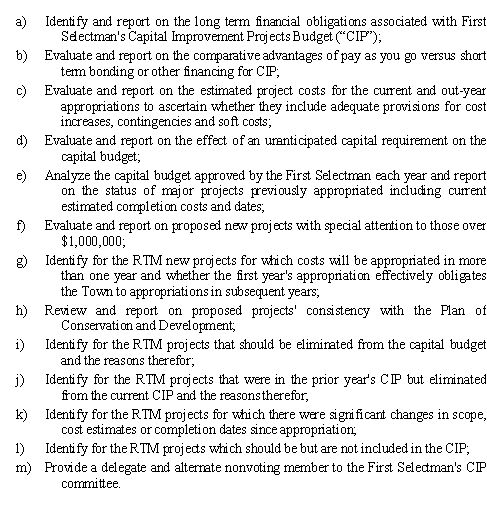
The Capital Projects Review Committee (“CPRC”) shall:
2. Composition:
The CPRC shall consist of twelve (12) members, one from each district, all of whom shall be members of the RTM and who shall be elected by their respective districts for terms expiring at the end of the term of the RTM during which they are elected, provided that the term of each member shall continue thereafter until a successor shall have been elected, and further provided that said members continue to be members of the RTM.
3. Election of Officers:
Within thirty days of the CPRC’s election by the districts, the Moderator will schedule an initial meeting of the CPRC, at which meeting the members shall elect from among its delegates a chairman, vice-chairman and secretary. Votes shall be recorded, and a majority of the committee members shall constitute a quorum. The newly elected chairman shall promptly notify the Town Clerk of such elections, and the Moderator shall announce the election of the committee officers at the next meeting.
4. Meetings:
The chairman shall convene CPRC meetings to plan and carry out the work of the committee. All meetings shall be posted in compliance with the Freedom of Information Act.
5. Reports:
The CPRC shall report to the RTM at its April meeting (or May if there is no April meeting) on its findings with regards to the proposed CIP appropriations and bonding, and shall recommend such action as it deems necessary to protect the Town's fiscal stability and interests. It shall also review the CIP process and recommend such changes as it considers advisable at the June RTM. It shall report to the RTM at such other times as it deems appropriate.
6. Minutes:
The minutes of all meetings of the CPRC shall be filed with the Town Clerk in compliance with the Freedom of Information Act. Such records shall be public records and shall be maintained for three terms after the end of the term to which they apply.
7. The CPRC shall automatically terminate two (2) years from the date the RTM approves the creation of the CPRC (the “Sunset Date”), unless a majority of the RTM members present at a meeting prior to the Sunset Date vote to extend the term of the CPRC.
EXPLANATORY COMMENTS
This resolution, which along with several other Special Committee resolutions, was postponed indefinitely by the RTM last October. However, before this resolution was postponed indefinitely, the RTM passed two amendments; one was to change the CPRC from a 7 person special committee to one in which each district is represented (Vote: 102-60-5). The second change made by the RTM was to insert a sunset clause (Vote: 98-76-1). Those two revisions have been incorporated into this draft of the proposal to create this new committee to review capital projects. Our vote on this resolution as revised is 11-0-0 with District 10 absent.
Here are the salient comments from the Special Committee, endorsing the creation of the CPRC, as they appeared in the October Call.
At present, there is no committee of the RTM charged with looking at our capital projects on an ongoing basis extending beyond the present budget. The Special Committee feels that a need has arisen to have a committee, presumably with financial expertise, and is therefore recommending that a new committee be formed.
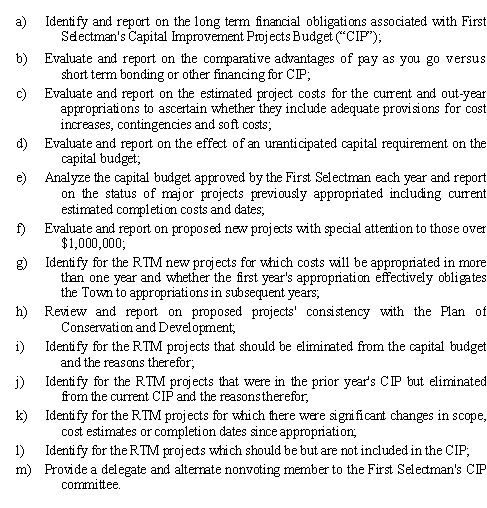
The new committee is to review all aspects of the CIP Budget including previously authorized projects, current recommended projects, and out year projects for their consistency with the POCD. The committee should also review financing approaches and the quality of cost estimates for these projects and make recommendations to the RTM on actions it should take at the May budget meeting. The new committee, to be called the Capital Projects Review Committee (CPRC), to avoid any confusion with the First Selectman’s “CIP” Committee, should also appoint a member and alternate member to the First Selectman’s CIP Committee.
The redlined version below shows the changes from the resolution that appeared on the October Call.
RESOLVED, that section VI.C of the Rules of the Representative Town Meeting be re-captioned VI.D and a new section VI.C be inserted.
The new VI.C. reads as follows:
C. CAPITAL PROJECTS REVIEW COMMITTEE
1. Function:
The Capital Projects Review Committee (“CPRC”) shall:
2. Composition:
The CPRC shall consist of twelve (12) members, one from each district, all of whom shall be members of the RTM and who shall be elected by their respective districts for terms expiring at the end of the term of the RTM during which they are elected, provided that the term of each member shall continue thereafter until a successor shall have been elected, and further provided that said members continue to be members of the RTM.
3. Election of Officers:
Within thirty days of the CPRC’s election by the districts, the Moderator will schedule an initial meeting of the CPRC, at which meeting the members shall elect from among its delegates a chairman, vice-chairman and secretary. Votes shall be recorded, and a majority of the committee members shall constitute a quorum. The newly elected chairman shall promptly notify the Town Clerk of such elections, and the Moderator shall announce the election of the committee officers at the next meeting.
4. Meetings:
The chairman shall convene CPRC meetings to plan and carry out the work of the committee. All meetings shall be posted in compliance with the Freedom of Information Act.
5. Reports:
The CPRC shall report to the RTM at its April meeting (or May if there is no April meeting) on its findings with regards to the proposed CIP appropriations and bonding, and shall recommend such action as it deems necessary to protect the Town's fiscal stability and interests. It shall also review the CIP process and recommend such changes as it considers advisable at the June RTM. It shall report to the RTM at such other times as it deems appropriate.
6. Minutes:
The minutes of all meetings of the CPRC shall be filed with the Town Clerk in compliance with the Freedom of Information Act. Such records shall be public records and shall be maintained for three terms after the end of the term to which they apply.
7. The CPRC shall automatically terminate two (2) years from the date the RTM approves the creation of the CPRC (the “Sunset Date”), unless a majority of the RTM members present at a meeting prior to the Sunset Date vote to extend the term of the CPRC.
DEPARTMENT: Property Owner
203-661-4033; 203-661-1570
REFERRED TO: Education, Finance, Land Use Committees
VOTES: N/A
Where as at a regular meeting held June 1 2010 the Town of Greenwich Planning and Zoning Commission adopted the following: “ Resolved the application of the Town of Greenwich Building Committee for the Greenwich High School Music and Instructional Space and Auditorium; PLPZ #201000065, for a municipal improvement , to increase the floor area from 412,945 square feet to 457,879 square feet through the construction of a new auditorium and stage house, create a secondary entrance plaza, maintain the 663parking spaces on site and 72 off site parking spaces, realign the bus loop and student parking along the east side of the school, add handicapped accessible parking spaces, realign the entry drive currently adjacent to the north of the science wing, restripe the northern parking lots, enlarge and reconfigure the western parking lot and minimize the footprint of the southern parking lot per section 99 of the Town of Greenwich charter on a 54.87 acre property located at 10 Hillside Road in the RA-1 and RA-20 zones as shown on architectural plans prepared by Perkins and Will, last revised 05/03/10 and engineering plans prepared by Diversified Technology Consultants, last revised 05/03/10 is here by approved”
Where as the Town of Greenwich Charter section 100 provides for the decision made by the Town of Greenwich Planning and Zoning Commission on any municipal improvement (MI) may be referred to the Representative Town Meeting (RTM) for consideration by any individual owning property in the Town of Greenwich.
Where as the RTM is the final authority on all municipal improvements (MI).
There fore be it resolved that the RTM has considered the referral made by Richard F. Kral jr., a property owner in the Town of Greenwich of the application for a municipal improvement,(PLPX #20100065) and hereby approves said application for municipal improvement.
EXPLANATORY COMMENTS:
RE: Municipal Improvement Status for the GHS Music Instructional Space and Auditorium Project
Municipal Improvement (MI) status is needed for projects that are new designs or renovations of a public real property or public building, including schools. Per section 100 of the Town Charter, the granting of an MI, which is given to the Planning and Zoning Commission (P&Z), can be referred to the RTM by any resident within 30 days of the posting of P&Z’s decision. By charter, the RTM is the final authority on all MI”s. The Board of Education (BOE) and the Board of Selectmen (BOS) both unanimously requested the granting of MI status for the Greenwich High School Music Instructional Space and Auditorium (GHS MISA). P&Z approved MI status and preliminary site plan approval for GHS MISA on June 1, 2010.
The purpose of this referral is to give the RTM the opportunity to review this project prior to the request for construction funding. It has been approximately three years since the RTM had the opportunity to review the MISA project. At this point, plans are no longer conceptual and construction estimates are more accurate. The RTM will be voting to either confirm the approval of the MI status for this project (a “yes” vote) or to reject the current project design and require the BOE and Building Committee to re-design the project (a “no” vote). If the RTM approves the MI, the RTM will have the opportunity to determine the project timing and funding through the approval of any construction appropriation in the budget process.
The planning for the Board of Education’s music instructional spaces and auditorium project has followed the Town’s three-phase process. Phase one was the feasibility study to determine need and scope. Phase two, the current phase, is developing more detailed architectural and engineering (A&E) plans to further understand project design and cost. Phase three will be the construction phase. The RTM approved the first phase for the MISA project in the fiscal year 2007-2008 budget with an allocation of $100,000 for the feasibility study. The ten year capital plan approved in the 2007-2008 Budget has “place holders” in fiscal year 2011- 2012 in the amount of $1,500,000.00 for A&E and $20,000,000.00 in fiscal year 2012-2013 for construction. The Board of Education completed the feasibility study in November 2007, determined that the existing facilities were inadequate for the current and future enrollments and for supporting the current and future uses of the spaces, and adopted educational specifications for the desired improvements. The BOE made the MISA project a priority and requested A&E funding of $2.13 million in the fiscal year 2008-2009 capital budget, with an estimated construction budget of $23.4 million for fiscal year 2009-2010. The A&E funding was approved by the RTM at its May 2008 meeting, followed by RTM creation of the building committee in June 2008. The current estimated project cost is $28.815 million, which is based on the detailed design development documents and a construction start date of July 2011.
Using the BOE-adopted Educational Specifications, the Building Committee designed music instructional classrooms that include new construction for the orchestra, band and electronic music programs, renovated space for the choral program and new construction for the auditorium and its supporting spaces. The project will bring GHS to be on par with the facilities of many of the other Fairfield County high schools, e.g., Darien, New Canaan and Wilton, and to meet State and national standards for the delivery of music instruction. The Building Committee utilized a series of consultants, including an architect, construction manager, acoustician, theater consultant, civil engineer, mechanical engineer, traffic consultant, etc. The Building Committee also met with residents of the neighborhood to understand and address their concerns wherever possible. A description of the project follows and renderings of the site plan and interior layouts are attached:
- Music instructional spaces are included for the electronic music, band, orchestra and choral programs. These spaces were sized based on the enrollment projections included in the Educational Specifications and on national standards for music education. The choral room will be housed in the existing music spaces with a raised roof, while the other music programs will be located in a new building that will be constructed at the location of the existing auditorium, which will be torn down. This new building will have a smaller footprint than the existing auditorium so will present a more appropriately scaled façade to Hillside Road. Appropriate small group instructional spaces, practice rooms, instrument storage and offices are included in the design. The design addresses the problems with sound quality and inadequate technology systems in the existing spaces.
- An auditorium was designed with seating for 1,325 (approximately 50% of the student enrollment per State guidelines) and with supporting spaces for theater and music programs. Seating occurs in three levels with 830 seats on the main floor, 305 seats in the mezzanine and 192 seats in the balcony. The design of the new auditorium was selected to address the acoustical problems, sightline limitations and mechanical system noises of the existing auditorium. This new building will be placed to the west of the science wing and north of the gymnasium. The exterior design is intended to blend with the existing building by using brick on the lower portions of the building, but adding a new component with metal panel.
- The galleria was designed to serve as the entry, pre-function and lobby space for the new auditorium and the existing gymnasium and to provide a venue for displaying student art exhibits. The main entrance will be highlighted by a glass wall and large canopied entrance in the parking lot on the west side of the building. The galleria will also have an east side entrance, giving access to the auditorium from the front and rear parking lots.
- Modifications to the site plan include maintaining the existing number of parking spaces but improving the number of compliant spaces and widening the driving lanes. The west lot will be extended 18’ towards the fields to accomplish the necessary improvement to safety and traffic flow. Exterior lighting will be improved to be more uniform throughout the parking lots and to reduce glare to neighbors. Parent drop-off and pick-up for the school is planned to be moved to the rear of the building at the new lobby entrance, with the goal of improving safety on Hillside Avenue and improving the separation of bus and car traffic.
- Environmentally-favorable design components including a green roof over a portion of the new music space near the main entrance, rainwater gardens, bio-swales to filter storm run-off, high efficiency air conditioning system and high efficiency LED lighting for the exterior and parking lots. Landscaping is being added for improved screening and visual impact.
The project has been approved by the Inlands Wetlands and Watercourses Agency (IWWA) and been granted preliminary site plan approval by P&Z. The project is currently seeking Architectural Review Commission approval and variances for height and FAR from Zoning Board of Appeals. If granted, the project will return to P&Z for final approval.
The budget for this project has been modified as more information is known about the project design, site conditions and construction timing. The following chart shows the budget estimates over time:
| |
GHS MISA
| |
| |
History of Budget Estimates**
| |
| |
~
|
~
|
~
|
| |
Request for
|
Schematic
|
Design
|
|
Request for feasibility study FY2007-08
|
A&E Phase
|
Design
|
Development
|
| |
FY 2008-09
|
FY 2009-10
|
FY 2011-12
|
|
Feasibility Study
|
100,000
|
100,000
|
100,000
|
100,000
|
|
~
| |
~
|
~
|
~
|
|
Arch & Engr Phase
|
1,500,000
|
2,130,000
|
2,130,000
|
2,130,000
|
|
~
| |
~
|
~
|
~
|
|
Construction Phase
| |
~
|
~
|
~
|
|
Hard costs
|
Na
|
Na
|
22,155,000
|
23,492,000
|
|
Technology/FF&E
|
Na
|
Na
|
1,710,000
|
1,505,000
|
|
Soft Costs
|
Na
|
Na
|
1,200,000
|
1,330,000
|
|
Contingency
|
Na
|
Na
|
2,750,000
|
2,488,000
|
|
Total Construction phase
|
20,000,000
|
23,400,000
|
27,815,000
|
28,815,000
|
|
~
| |
~
|
~
|
~
|
|
Total Project Cost
|
$21,600,000
|
$25,630,000
|
$30,045,000
|
$31,045,000
|
** Cost estimates have increased over time as the project has gotten more definition and benefitted from the detailed work of the architect and other project consultants. Specifically, the construction cost has increased due to more difficult building conditions than anticipated at the site, necessitating more blasting, water issues and structural supports. Additionally, there are increased site costs to address higher landscaping, lighting, water run-off issues, and paving costs. Building costs have also been impacted by design details to address handicap access and other building regulations.
By referring the MISA project to the RTM at this stage of the planning process, RTM members have an opportunity to understand the project prior to the finalization of all design decisions. RTM members can use the developed project design documents to base decisions and formulate input. The questions raised by the RTM in previous discussions of this and other Town projects include parking capacity, traffic concerns, and effective planning that considers existing site/building issues and future site needs.
- Parking: This plan is parking neutral in that there will be the same number of spaces after completion of the construction as exist currently. During the feasibility study, the BOE considered and rejected the addition of a parking structure to increase the number of spaces.
- Comprehensive Site Plan: The Building Committee has completed site plans for GHS to include the impacts and needs of this project. Future needs of the athletic fields (like water fountains and bathrooms) have not been included in the site plans. The BOE anticipates incorporating, where possible, running conduits and water lines underneath the new parking lot to be prepared for future needs.
- Engineering - Heating and Cooling Plant: The Building Committee has designed an HVAC (heating, ventilation and air conditioning) system that addresses the needs of the new and renovated spaces added by this project. This design does not address any capacity or design problems with the existing HVAC systems at the school and does not add cooling to any existing areas, like the gym. However, the design does not worsen the performance of the existing HVAC system or preclude future changes for other parts of the building.
- Fund raising: The BOE has adopted guidelines for fund raising and naming rights. The policy has been developed solely for the MISA project.
Due to land use regulations and forecasted student enrollment, the MISA project will be the last major improvement to the Town’s only high school. Careful consideration of the site plan, building design and funding requirements are important at this stage of the project. The RTM however is not a planning body. The responsibility for planning an MI is vested in the applicant, building committee and the Town of Greenwich land use agencies. The decision the RTM is afforded, as the final authority on an MI, is whether the project is something the Town can financially support and is the project properly planned.
ATTACHMENTS :
Separate packet
|